The Questions Change as Retirement Gets Closer
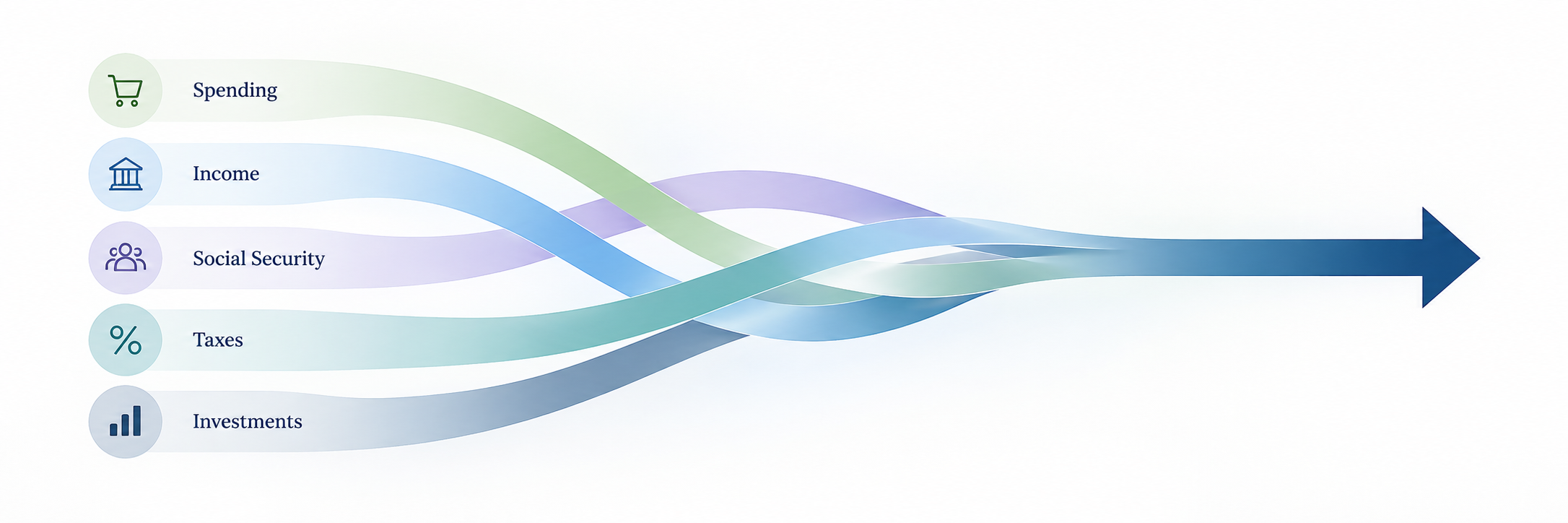
For much of your working life, the financial focus is on saving and accumulating assets. As retirement approaches, the focus shifts to how those resources will actually be used.
How much can we reasonably spend?
Where should our retirement income come from?
When should we claim Social Security?
Should we make Roth conversions or other tax-related moves?
How should we withdraw from our accounts?
How should our investments change once we begin spending from them?
Each question matters on its own. The difficulty is that the answers are connected.
Retirement Decisions Affect What Comes Next
A retirement decision rarely affects only one part of your finances.
Claiming Social Security changes how much income needs to come from other resources. A Roth conversion may increase taxes today but change future withdrawals and required minimum distributions. Spending decisions affect how much income the portfolio must support. And investment decisions depend on when those assets may be needed and what responsibilities they are expected to fulfill.
The challenge is not simply making a reasonable decision today. It is understanding how that decision affects the choices that follow.
A retirement plan may establish an initial direction, but decisions do not end when the plan is completed. Income sources begin and end, spending requirements change, tax considerations shift, and investments take on different responsibilities. Those decisions and their consequences must be carried forward as retirement unfolds.
That is why our work is centered on ongoing retirement coordination—connecting decisions across spending, income, taxes, and investments, then revisiting them when circumstances or new information warrant attention.
The Retirement Coordination Framework™
Retirement decisions become easier to evaluate when they are addressed in the right sequence.
The Retirement Coordination Framework™ begins with the spending your resources need to support, then works through income, taxes, and investments in that order.
Each step gives the next step something to solve.
SPENDING →
What needs to be supported?
Spending Requirement
Establishes how much your retirement resources need to support and when those resources may be needed.
INCOME →
Where will it come from?
Income Architecture
Determines how spending will be funded and what must come from investment resources.
TAX →
How should income be produced?
Tax Sequencing
Evaluates the tax consequences, timing, and sequencing of income and withdrawal decisions.
INVESTMENT
How should assets be positioned?
Investment Alignment
Determines how assets are positioned according to the responsibilities they are expected to fulfill.
The sequence matters. Investment decisions are not the starting point. They follow from the spending, income, and tax decisions the portfolio is responsible for supporting.
The framework establishes the order in which decisions are evaluated. Our ongoing advisory relationship provides the continuity to carry those decisions forward, review their effects, and make adjustments when needed.
A specific question may bring you to the firm. We address it within your retirement structure and continue coordinating the decisions that follow.
Explore the Retirement Coordination Framework →
Retirement Coordination Continues Over Time
Retirement does not create one set of decisions that can be made once and left in place.
Spending changes. Social Security begins. Roth conversions may become appropriate. Required minimum distributions start. Medicare-related thresholds matter at different times. Portfolio withdrawals and charitable giving can create new tax and investment considerations.
Our annual planning rhythm creates regular points to review what has changed, determine which decisions require attention, and carry those decisions forward.
Ongoing coordination does not mean making changes simply because another review has arrived. Sometimes the appropriate decision is to maintain the existing approach. The purpose of regular review is to determine what needs attention, what can remain in place, and what may need to be addressed later.
Tax & Income Alignment Review
Use completed tax results to calibrate current-year income and tax decisions.
Spring Planning
Review spending, income, taxes, and investments and establish direction for the year ahead.
Fall Strategy Review
Address year-end decisions and considerations for the coming year.
Mid-Year Snapshot
Assess what has changed and identify matters requiring attention.
Year-End Review
Summarize completed work and identify matters carrying into the next planning cycle.
Retirement coordination is ongoing because the decisions, timing, and circumstances continue to change.
See how the annual planning rhythm supports that process throughout the year.

go deeper into the framework
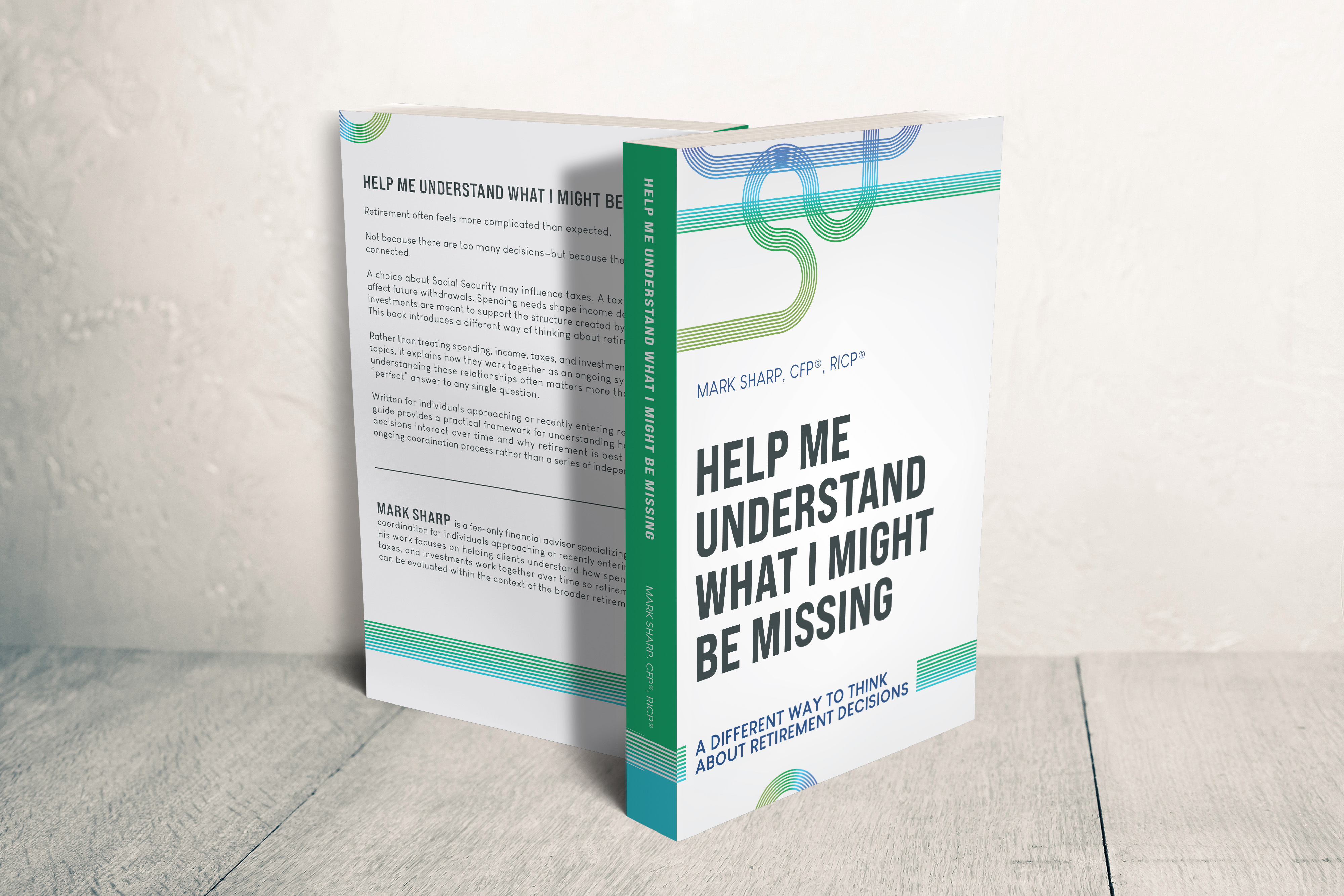
A different way to think about retirement decisions.
The framework on this page provides the structure. This guide shows what happens when you put it to work.
The obvious question is rarely the whole question.
A decision about Social Security may also affect portfolio withdrawals, taxes, Medicare premiums, and how investments are used. A tax decision today may change the choices available years from now.
Using common retirement decisions, the guide shows how spending, income, taxes, and investments interact—and why the order in which they are considered matters.
In about an hour, you’ll have a practical way to evaluate the question in front of you and recognize what it may affect next.
Prefer a printed copy? Paperback editions are available through Amazon.
Who We Are a Good Fit For
We work best with people approaching retirement and those in the early years of retirement who have accumulated the resources to retire and now need to decide how those resources should be used over time.
You're likely a good fit if you:
- Are within five years of retirement or recently retired
- Are shifting from accumulating assets to using them to support retirement
- Want retirement decisions evaluated in relation to one another rather than one at a time
- Value an ongoing advisory relationship as circumstances, priorities, and decisions change
- Prefer a structured process for deciding what needs attention now and what can wait
Our work is designed for people who have largely completed the work of accumulating retirement resources and now want a structured, ongoing process for deciding how those resources should be used, when decisions require attention, and how those decisions affect one another over time.
Who We Are Not a Good Fit For
We may not be the right fit if you:
- Are many years from retirement and primarily focused on accumulating assets
- Are looking for help with a single financial question, isolated recommendation, or one-time analysis
- Prefer to address financial decisions only as they arise rather than through an ongoing advisory relationship
Explore Whether Our Approach Fits
If you're approaching retirement or recently retired and want spending, income, taxes, and investments coordinated through an ongoing advisory relationship, we invite you to tell us about your needs.
The firm does not offer hourly consultations. The introductory meeting is an opportunity to discuss whether ongoing advisory services are a good fit; it does not include individual financial recommendations.
Meeting requests are reviewed before an appointment is confirmed.